

30 Agents Every AI Engineer Must Build: An Honest Review After Three Months With the Book
An honest, in-depth review of 30 Agents Every AI Engineer Must Build by Imran Ahmad (Packt). Why the book is really a pattern library for production agent engineering, not a catalog of 30 demos.
Back in April, Dipali Malwatkar (Growth Lead, LLM Engineering at Packt) reached out and sent me a copy of 30 Agents Every AI Engineer Must Build by Imran Ahmad. It landed on my desk on 24 April 2026. I did not want to write a review off the table of contents and a skim, so I sat with it for three months and actually built against it. This is that review.
The short version: the title undersells the book. It sounds like a listicle in hardcover. It is not. This is a book about agent engineering as a discipline, and the "30 agents" are the vehicle, not the point.
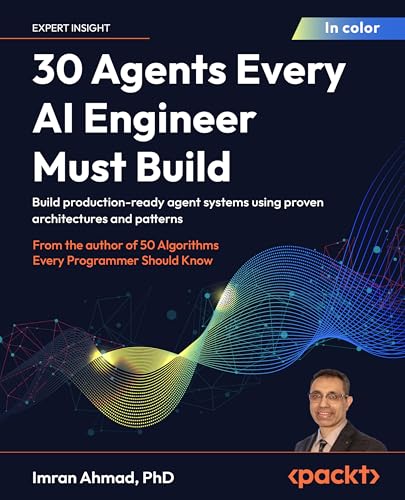
Quick verdict: 30 Agents Every AI Engineer Must Build is a pattern library disguised as a catalog. Its real subject is the architecture around the model, not prompting tricks. Best for engineers moving from LLM features to production agent systems.
What most reviews get right, and what they miss
The public conversation around this book is still thin, which makes sense for a 2026 release. Packt and Amazon list a 4.5 rating, and the recurring praise is fair: people call it practical, architecture-first, and production-minded. Goodreads notes that it moves cleanly from basic to advanced multi-agent thinking.
All true. But that generic praise misses the actual thesis, and the thesis is the reason the book is worth your time.
Most agent books teach you to call a model well. This one teaches you to build the system around the model. The preface says it plainly: the shift from LLM apps to agents is architectural, not incremental, and raw model calls are not enough. Everything after that earns the claim.
The hidden idea: the agent is the architecture, not the model
If you take one sentence away from the book, make it this:
Ahmad keeps returning to a single core loop, the cognitive loop of perception, reasoning, planning, action, and learning, and treats everything else (interoperability, lifecycle, prompting, deployment, security, governance) as part of agent engineering rather than as cleanup at the end.
That is why the first third of the book matters more than the "30 agents" framing suggests. Chapter 1 gives you the vocabulary: what actually separates an agent from a script (autonomy, persistence, reactivity, proactiveness, adaptability, goal orientation), the reactive/deliberative/hybrid families, protocols like MCP and A2A for connecting to tools and other agents, and an Agentic AI Progression Framework for classifying maturity from manual operations up to learning agents.
By the time you reach the domain chapters, the point is unmistakable. Healthcare, finance, law, education, and robotics do not need "magic agent prompts." They need different control structures, memory models, validation gates, and escalation rules.
Why the structure is the argument
The book is built so the foundation carries the rest, and that ordering is deliberate:
- Chapters 1 to 4 build the operating system: agent foundations, the toolkit (LangChain, LangGraph, LlamaIndex, CrewAI, AutoGen, vector databases, cloud platforms), prompting, and deployment with security and responsible AI.
- Chapters 5 to 10 are the reusable building blocks: cognitive architectures, retrieval and knowledge, tool orchestration, analysis and verification, software agents, and conversational or content systems.
- Chapters 11 to 16 adapt those blocks to hard domains: multimodal perception, ethics and explainability, healthcare, finance and law, education, and embodied or physical-world systems.
- Chapter 17 looks forward to agent societies, governance, and organizational roadmaps.
Read that way, "30" is less a count and more a curriculum. You learn what kinds of agent problems exist, which architecture each one needs, and what breaks when you reach for the wrong one.
The patterns that actually stuck with me
These are the parts I kept coming back to while building, not the parts that just read well.
Two lines from the book capture the tone well:
"This transformation is architectural, not merely incremental."
"Raw LLMs alone are not enough."
The companion GitHub repository is worth pulling down. It ships executable, per-chapter code (with a simulation mode so you can run patterns without wiring up every external service) and it is the fastest way to feel the difference between reading a pattern and running it.
Where it falls short (the honest part)
No book earns a real review without the criticism, so here is mine.
Breadth wins over depth, and you can feel it. Across 542 pages and 17 chapters spanning software, healthcare, law, finance, education, multimodal systems, and robotics, some later domain chapters read more like strong reference architectures than end-to-end implementation manuals for someone already deep in that field. That is a defensible tradeoff for a pattern library, but go in expecting a map, not a fully paved road, in the vertical chapters.
The stack will age faster than the ideas. The book names concrete frameworks, models, and versions. Useful today, dated in eighteen months. The architectural distinctions (reactive versus deliberative, single agent versus chain-of-agents, generation versus verification, autonomy versus governance) are the part that will still hold.
Case studies are illustrative, not field-validated. The companion material notes that several "real-world" scenarios use fictional companies navigating real constraints. Good for teaching, but read the business outcomes as scenario design, not independent proof.
The hands-on path leans LangChain and LangGraph. Not a flaw so much as a bias worth knowing before you start.
How it compares to typical AI agent books
| Aspect | This book | Typical recent agent books |
|---|---|---|
| Depth and structure | Foundations first (cognition, lifecycle, prompting, deployment, ethics), then 30 applied patterns | Often start with quick builds and explain architecture only lightly |
| Production focus | Security, verification, explainability, and human oversight are core chapters | Frequently treated as add-ons after the happy path |
| Code and prerequisites | Executable companion repo with simulation mode, but assumes Python and basic ML | Easier to start, but often leave the gap between demo and deployment to you |
| Best fit | Engineers moving from LLM features to production agents | Readers wanting a fast intro or a single-framework tour |
Who should actually read it
Read this if you already know Python and basic ML and you are trying to move past "prompt in, answer out" into systems that plan, act, verify, and operate under real constraints. If you build agents that touch production, or you want a mental model that survives your current framework, this is one of the more grounded books on the topic.
Skip it, or borrow it, if you only want a quick single-framework tutorial or a weekend of copy-paste demos. That is not what this book is trying to be.
If agent infrastructure is your world, it pairs well with where the platforms are heading. I wrote about that shift in my Databricks Data + AI Summit 2026 breakdown, where the story was almost entirely about operating and governing agents at scale, which is exactly the muscle this book trains.
Final word, and a thank you
30 Agents Every AI Engineer Must Build is really a field guide to agent engineering wearing a catalog's cover. The "30 agents" are 30 reusable architectures you can combine, and the enduring value is the engineering judgment underneath them. It is not a perfect book, the breadth costs it some depth, but it is an unusually honest and useful one. 4.5 / 5, and it has earned a permanent spot on my shelf.
Thank you, Dipali Malwatkar, for reaching out and sending the book. I appreciate the trust, and I hope this review does it justice by going past the blurb.
And a real thank you to Imran Ahmad for writing it. It is clear every pattern was pressure-tested against the production realities of latency, cost, reliability, and security, and that care shows on the page.
You can find the book on Amazon and via Packt, and the code on GitHub. If you read it, I would genuinely like to hear which of the 30 patterns you reached for first.
Frequently asked questions
What is 30 Agents Every AI Engineer Must Build about?
It is a 542-page, 17-chapter book by Imran Ahmad (Packt, 2026) that teaches agent engineering through 30 reusable agent architectures. The first third builds foundations (the cognitive loop, prompting with PTCF, deployment, security, and governance), then reuses those building blocks across retrieval, orchestration, verification, software, conversation, multimodal, regulated domains, and robotics.
Who should read this book?
AI engineers and backend developers who already know Python and basic ML and want to move past simple RAG or chatbot demos into agents that can plan, act, verify, and operate under constraints. It is less useful if you only want a quick single-framework tutorial.
Is the book just 30 separate agent tutorials?
No. The 30 agents are better read as 30 composable architectures, not 30 disconnected projects. The real value is a shared vocabulary (cognitive loop, memory, tool orchestration, verification, governance) that you mix and adapt per problem, backed by an executable companion GitHub repository.
What is the main weakness of the book?
Breadth over depth. Because it spans software, healthcare, finance, law, education, multimodal, and robotics, some later domain chapters read more like strong reference architectures than end-to-end implementation manuals. The framework and version-specific material will also age faster than the architecture chapters.
 Written byBrian CastelinoEngineer and writer. This is his personal blog about technology, the things he builds, and ideas he is working through.